Violent Responses to Rebellions and the Fear of Rebellions
Scroll for moreAfter the Haitian revolution, plantation owners reacted violently to the mere hint of rebellion.
The 18th century closed with a series of global uprisings: the American Revolution ending in 1785, the Haitian Revolution in 1791, and the French Revolution concluding in 1799. In a radical shift away from absolute monarchy, colonized citizens and former royal subjects demanded full representation within their government systems, and fought costly and violent battles to enforce their demands. The example of Haiti, where enslaved Africans fought and won their freedom, led American plantation owners to fear that enslaved Africans within their own borders might do the same. In response, revolts against slavery in the United States were suppressed with extraordinary violence.

In 1803, many American newspapers featured concurrent coverage of the Haitian Revolution and the trial of Virginia insurrectionist Gabriel Prosser, an enslaved man arrested before initiating a planned rebellion. Trial proceedings revealed that Prosser and his co-conspirators had been inspired by the American, French, and Haitian revolutions, expected support from France, and even reported an alliance with two French nationals. This coverage elevated Gabriel Prosser to national news during the 1800 presidential contest between Thomas Jefferson and John Adams, and fueled white fears of an enslaved uprising. The Pennsylvania Gazette warned that a “general massacre of the whites” could spread through the South and urged, “Tell these things in South Carolina! Yea, let them be published in the state of Virginia!”
Enslaved people in the United States continued to mount rebellions throughout the 19th century, and responses were swift and brutal. In 1811, after federal troops and local white militia defeated Charles Deslondes and 500 other enslaved people who mounted a revolt in what is now Louisiana, 95 enslaved people were convicted and executed in military proceedings. Afterward, Deslondes’s corpse was mutilated, dismembered, and publicly displayed, while the decapitated heads of his followers were mounted on pikes spanning over 60 miles on the route to New Orleans as a warning to other enslaved people contemplating rebellion.
Similarly, at least 30 enslaved African Americans were executed in response to the discovery of Denmark Vesey’s plans for insurrection in Charleston, South Carolina, in 1822. When enslaved minister Nat Turner led dozens of Black people in a bloody revolt against slavery in Southampton, Virginia, in 1833, white forces responded by attacking local Black communities and killing an estimated 120 people – including many who had no connection to the revolt. Nearly 20 enslaved people, including Turner, were convicted and executed. In 1835, after fear spread that Black preachers were plotting insurrection, plantation owners in Mount Vernon, Virginia, lynched several Black preachers and, like in Louisiana, placed the men’s heads on poles along the roadside as a warning.
The use of deadly violence as an attempt to intimidate and terrorize enslaved Black people into submission did not prevent the eventual abolition of slavery. But the use of violence by white community members to maintain racial control persisted for nearly a century.
To protect slavery, many Americans embraced religious teachings that endorsed Black inferiority.
As early as the 10th century, the Bible was used to support the claim that Africans were a cursed people fit only for slavery. Religion became a more common justification for slavery as national economies grew dependent on maintaining the system of bondage. Enslaved labor grew to be a major source of economic enrichment and the basis for a strictly-enforced racial caste system rooted in white supremacy. To protect slavery, the American colonies and later the United States embraced religious teachings that endorsed ideas of Black inferiority, approved the inhumanity of chattel slavery, and promised reward to Black people who submitted to enslavement.
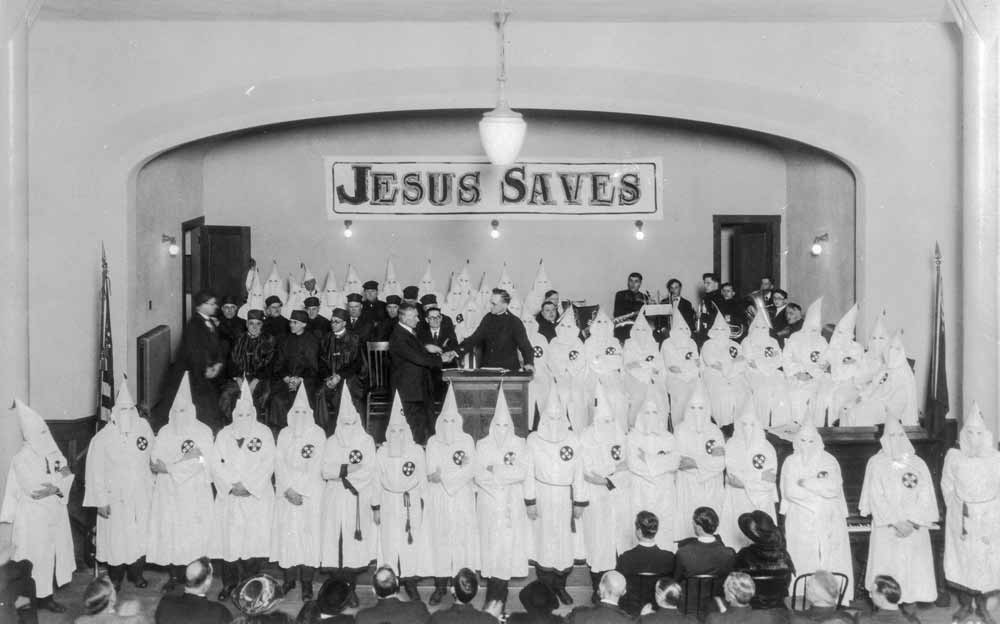
KKK welcomed to Baptist Church service in Portland, Oregon, 1922.
Photo: Oregon Historical Society, OrHi 51017
When slavery began in North America in the 17th century, the lands that would become the United States were colonies held by the British. At that time, British policy forbidding the enslavement of Christians did not apply to most Africans, who practiced Islam or African folk religions. As missionary efforts to convert enslaved Africans to Christianity grew in the colonies, British slaveowners worried that their legal rights to hold human property would be threatened if Africans were no longer seen as non-Christian heathens. This fear was realized in 1656 when Elizabeth Key, the daughter of an enslaved Black woman and a white Englishman, successfully sued for her and her child’s freedom by arguing that her Christianity shielded her from enslavement. If slavery was to survive, religious teachings had to adapt.
In the early 1660s, a British minister named Richard Baxter published a treatise encouraging slaveowners to convert enslaved people to Christianity. He argued that slavery was a righteous institution that allowed for the saving of African souls without requiring their freedom. He told his Puritan readers that slavery was beneficial to African people, and his treatise paved the way for white people to buy, sell, and abuse African people while maintaining their Christian identity. Compatible laws soon followed.
In 1667, the colony of Virginia declared that Christian baptism did not exempt enslaved Black people from bondage, and New York and Maryland soon did the same. These laws allowed white evangelicals to share Christianity with Black people without the risk of forced emancipation; later laws restricted Black Christians’ religious practice and barred interracial worship services. After the colonies won independence and established the United States, these laws expanded.
As the abolitionist movement grew in the North, some openly challenged the church’s tolerance of slavery. But Southern churches, largely dependent on the support of white slaveowners, almost never questioned the morality of owning human beings. As late as 1857, Mississippi Governor William McWillie declared it the South’s Christian duty to maintain slavery, and praised its effect: “In no period of the world’s history have three millions of the negro race been so elevated . . . or so much civilized or Christianized as those in the United States as slaves.”