Violence Against Black Families
Scroll for moreThe domestic slave trade devastated Black families, roughly half of whom were separated due to sale.
Slavery severely weakened Black people’s claims to the most basic social bond: the family. Enslaved people could not legally marry, and even when they were given permission to marry informally, husbands and wives were powerless to protect themselves from being sold away from each other. Spouses often were forced to live on separate plantations if “owned” by different slaveowners. Parents could do nothing when their young children were sold away, and enslaved families were regularly separated at an owner’s or auctioneer’s whim, never to see each other again. Slaveowners and traders wielded the fear and trauma of familial separation to control and torment enslaved people.
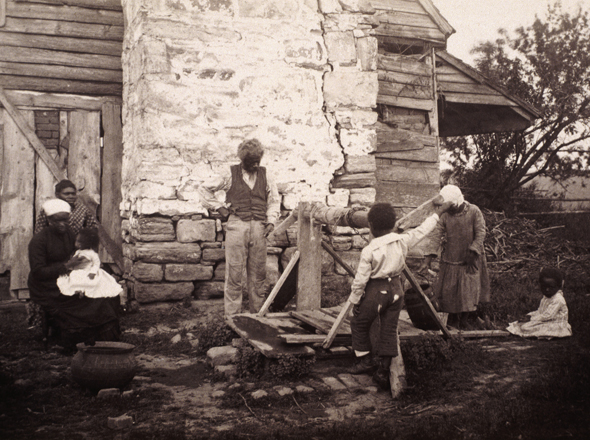
The domestic slave trade that thrived in the United States after Congress outlawed the international slave trade in 1808 was a physically brutal and inhumane enterprise that devastated Black families. Roughly half of all enslaved people were separated from a spouse or parent due to sale – as many as 150,000 people in Alabama alone – and about one in four of those sold were children. Ads for the Thomas L. Frazer & Co. Slave Mart in Montgomery, Alabama, boasted having “constantly on hand a large and well selected stock” of Black boys and girls.
Slaveowners threatened to sell enslaved people as punishment for disobedience, terrorizing families with the prospect of being separated from their loved ones. In 1820, a group of enslaved people in Virginia shared that the risk of being sold away from their families “was a cruel part of their condition and one of the main causes of stress and anxiety in slave quarters throughout the state.” An enslaved man in North Carolina was constantly worried that his wife would be sold away from him, just like his first two wives.
Enslaved people could be sold away from relatives at an owner’s whim, to divide an estate or settle a debt. In South Carolina, courts conducted half of all sales of enslaved people and mostly sold individuals. In Missouri, 30 percent of enslaved people sold by the court were younger than 15 years old.
“Babies was snatched from their mother’s breast and sold to speculators,” recalled Delia Garlic, a formerly enslaved Black woman from Montgomery, Alabama. “Children was separated from sisters and brothers and never saw each other again. ‘Course they cry; you think they not cry when they was sold like cattle? I could tell you ‘bout it all day, but even then you couldn’t guess the awfulness of it.”
Freedom came to represent both individual liberty and the opportunity to protect – or restore– familial bonds. After Emancipation, formerly enslaved people used newspaper ads, church bulletins, and word of mouth to search for family members lost through sale, sometimes decades before. Though often unsuccessful, their efforts illustrate the enduring bonds of family and the enduring pain of separation.