Lethal and Abusive Working Conditions
Scroll for more"[T]he whip was as important to making cotton grow as sunshine and rain."
Enslaved Black people faced abusive and sometimes deadly working conditions, especially in the Southern cotton industry. On every cotton plantation, physical abuse and torture featured prominently among the management tactics of slaveowners eager to maximize production at the expense of Black people’s humanity. As historian Edward E. Baptist wrote, “[T]he whip was as important to making cotton grow as sunshine and rain.” American plantation owners became incredibly wealthy, powerful, and privileged by cruelly exploiting the labor of enslaved Africans.
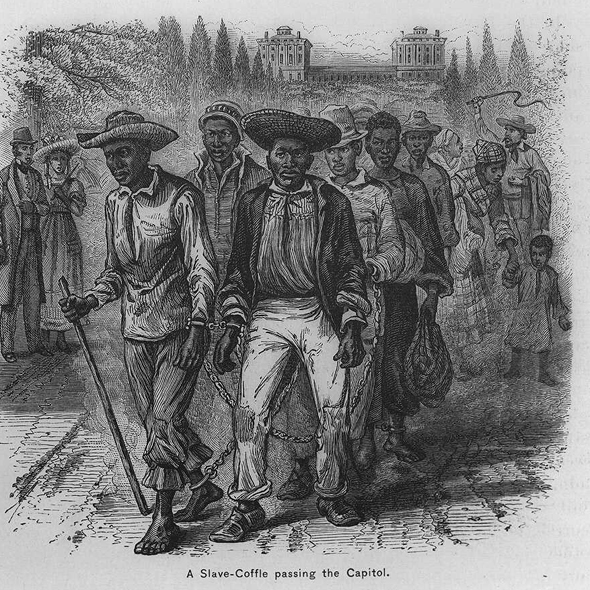
Slaveowners tried to ensure the highest level of productivity by purchasing strong Black men and women of “prime age,” between 15 and 25 – old enough to have survived childhood, sturdy enough to tend cotton, and old enough to reproduce and supply the owner with more laborers. If an enslaved person had skills in carpentry, masonry, cooking, or some other craft, and had no history of escape, he or she had increased value on the auction block.
From 1800 to 1860, cotton production in the United States increased by almost 400 percent. That growth came at an immense human cost. Unsanitary conditions, inadequate nutrition, crude living quarters, and unrelenting hard labor, combined with extreme heat and humidity, put enslaved people at high risk of contracting diseases like malaria, and they were often forced to work while sick. Mortality rates among enslaved children averaged a shocking 66 percent; on one rice plantation, fully 90 percent of the children died.
Overseers patrolled the fields to supervise enslaved laborers. Selected for their “hardness,” they were expected to severely punish enslaved people for tardiness, defiance, working too slowly, trying to escape, and any other fault, with “whippings, torture, mutilation, imprisonment, being sold away from the plantation,” and even death. Women were especially vulnerable to being accused of “slacking” due to physical limitations, fatigue, pregnancy, or child care responsibilities.
An enslaved woman named Lydia was forced to lay on her stomach and bare her back and buttocks after she arrived one minute late for evening roll call. As another enslaved woman held her infant, Lydia “screamed and writhed” with each blow of the overseer’s plaited cowhide: “Her flesh shook. Blood rolled off her back and percolated into the packed, dark soil of the yard.”
Children were brutally punished when they resisted the demands of work. In a letter to a cousin, a slaveholding white woman described the killing of a child no more than 18 months old. “Gross has killed Sook’s youngest child,” she wrote. ” [B]ecause it would not do its work to please him[,] he first whip it and then held its head in the creek branch to make it hush crying.”