Convict Leasing
Scroll for moreSlavery did not end with Emancipation -- it evolved into convict leasing.
Involuntary servitude did not end in 1865, it simply evolved. After the Civil War, slavery persisted in the form of convict leasing, a system in which Southern counties and states leased Black prisoners to private railways, mines, and large plantations. While states profited, prisoners earned no pay and faced inhumane, dangerous, and often deadly work conditions. Convict leasing replicated the institution of slavery, with similar inhumane and lethal consequences for Black people.
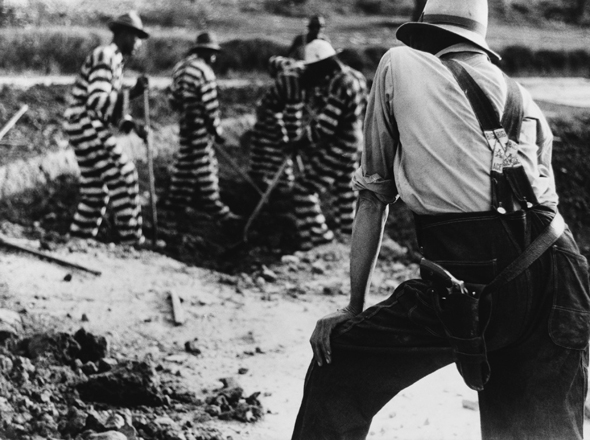
The Thirteenth Amendment to the United States Constitution, ratified in 1865, prohibited slavery and involuntary servitude, but explicitly exempted those convicted of crime. In response, Southern state legislatures quickly passed “Black Codes” – new laws that applied only to Black people and subjected them to criminal prosecution for “offenses” like loitering, breaking curfew, vagrancy, having weapons, and not carrying proof of employment. These laws were crafted to ensnare and commodify freedmen and return them to bondage. As a Mississippi statute from 1866 read:
“If any freedman, free negro, or mulatto, convicted of any [] misdemeanor[] shall fail or refuse for the space of five days, after conviction, to pay the fine and costs imposed, such person shall be hired out by the sheriff or other officer, at public outcry, to any white person who will pay said fine.”
Leased African Americans were separated from their families and frequently beaten, bound, and starved. Those who managed to escape were described in “Reward Proclamations” eerily similar to runaway slave ads. Some, like 14-year-old Ransom Roland, who fled Sandy Bayou Camp in Mississippi on February 5, 1896, while serving a three-year burglary sentence, were just children.
Many scholars believe this system was “worse than slavery,” because leased convicts were less valued, more easily replaced, and regularly worked in dangerous conditions. In 1870, Alabama prison officials reported that more than 40 percent of their convicts had died, and in 1887, a Hinds County, Mississippi, grand jury review of the state’s penitentiary system reported that more than 20 percent of the convict workers leased on one contract were dead or seriously ill within just six months. “God will never smile,” the investigators concluded, “on a State that treats its convicts as Mississippi does.”
Convict leasing persisted for generations, ensnaring thousands of Black people well into the 1930s. Industrialization, economic shifts, and political pressure made the practice less sustainable by the mid-20th century and it had largely ended by World War II. But the Thirteenth Amendment’s dangerous loophole still persists.